Best for local multi-stop meetings: hourly chauffeur charter. Best for recurring corporate bookings: Mayline corporate accounts. Best for a single meeting transfer: point-to-point car hire. This 2026 guide matches each arrangement to your roadshow schedule, luggage and booking needs.
- For corporate roadshow car charter hong kong planning, choose hourly hire when the car must stay between meetings.
- Mayline corporate accounts suit recurring business bookings, with monthly settlement available by written agreement.
- Use point-to-point transfers for separate journeys; use airport transfers when flight tracking matters.
- Treat cross-border meetings as a separate transport plan because passenger clearance affects the itinerary.
Why this matters
A corporate roadshow needs more than a car at the first hotel. You need to decide whether the driver stays between meetings, who handles changes and where luggage goes while your team is inside.
For a 2026 itinerary, choose the service around the working day rather than the vehicle badge. An hourly charter, an airport pickup and a cross-border transfer solve different problems. A corporate account adds booking administration; it does not replace choosing the right journey type.
What makes the best corporate roadshow car charter?
Use these criteria before comparing arrangements:
- Driver continuity: Decide whether you need the car retained between meetings or only for individual transfers.
- Passenger and luggage fit: Count every traveller, suitcase and presentation bag before choosing a vehicle.
- Route coverage: Separate Hong Kong journeys from Macau and mainland China travel.
- Charge boundaries: Check which arrangements include tolls and which require parking or toll payments on the day.
- Change handling: Give one person responsibility for the itinerary and booking amendments.
- Business administration: Match payment, passenger tracking and statement requirements to your company’s process.
A suitable option meets your actual agenda. An airport pickup with flight tracking does not, by itself, reserve a driver for the rest of your meeting day.
Hong Kong roadshow transport options at a glance
The table ranks booking arrangements by their role in a corporate roadshow, not competing vehicle operators. Choose the relevant use case rather than treating every row as a substitute for every other row.
| Option | Best for | Standout feature | Key limitation |
|---|---|---|---|
| Hourly chauffeur charter | Local multi-stop meeting days | A booking structured around a period of vehicle use | Minimum booking duration; parking and tolls need attention |
| Mayline corporate account | Recurring company or guest bookings | Booking portal, change requests and agreed monthly settlement | An account is not a vehicle reservation |
| Point-to-point private car | A single scheduled meeting transfer | A defined pickup and destination | Does not reserve the car between separate journeys |
| Airport transfer | Flight-linked arrivals | Flight tracking and a defined pickup process | Does not automatically cover later meetings |
| Cross-border private car | Regional meetings outside Hong Kong | A journey arranged for the relevant border route | Passport checks and passenger clearance remain necessary |
1. Hourly chauffeur charter: best for multi-stop roadshows
An hourly charter fits a day with several meetings and gaps between them. You book driver time rather than treating each movement as a separate journey.
For a Hong Kong roadshow, this is the default arrangement when your team needs transport throughout the day. The available charter format runs from 4 to 14 hours, with a 4-hour minimum.
Hourly chauffeur charter pros:
- Matches a sequence of meetings rather than one destination.
- Gives the organiser a defined period of booked vehicle use.
- Avoids structuring every leg as an independent transfer.
Hourly chauffeur charter cons:
- The minimum duration is unnecessary for a short, isolated journey.
- Parking and tolls are paid on the day rather than included in the charter charge.
- A reserved car does not guarantee parking immediately outside each building.
Before booking, send the pickup location, meeting addresses, expected departure times and final drop-off. Identify gaps during which the team needs the car and gaps during which it does not.
Check building access separately. A meeting address is not always a usable pickup instruction; your organiser should confirm the entrance and collection point with the venue.
Best for: A team attending several Hong Kong meetings within one working day.
Verdict: Buy hourly charter when the driver needs to stay available between meetings. Skip it for one short transfer.
2. Mayline corporate account: best for recurring coordination
A corporate account addresses the administration behind repeat roadshows, company travel and guest transport. It supports bookings and change requests through a web portal, with monthly settlement available by written agreement.
Mayline corporate accounts suit businesses that need recurring roadshow transport and central booking administration. Monthly statements are available by currency in CSV format, and each booking has a neutral passenger tracking link without login or prices.
Corporate account pros:
- Centralises bookings and change requests.
- Supports monthly settlement when agreed in writing.
- Lets organisers forward a neutral tracking link to guests.
- Provides monthly statements by currency for reconciliation.
Corporate account cons:
- Account arrangements require a written agreement for monthly settlement.
- Opening an account does not reserve a car for a particular date.
- The organiser still needs to choose hourly hire or the appropriate transfer service.
For a recurring 2026 programme, define who can request changes and who approves them. Keep guest-facing information separate from the company’s payment administration.
This option is particularly relevant when the person booking does not travel. The passenger tracking link lets the organiser share journey information without exposing booking prices.
Best for: Companies, hotels, travel agencies and destination management companies coordinating repeat bookings.
Verdict: Buy through a corporate account for recurring administration. Skip account setup as the main decision for an isolated journey.
3. Point-to-point private car: best for one meeting transfer
Point-to-point car hire covers a defined journey between a pickup and destination. Choose it when you need to reach a meeting but do not need a driver retained while you attend.
This arrangement also suits a final transfer after a roadshow ends. It keeps the booking scope tied to a specific movement rather than a period of vehicle use.
Point-to-point private car pros:
- Gives the booking a clear origin and destination.
- Avoids an hourly charter minimum for a standalone journey.
- Includes tolls, tunnel and border fees in the point-to-point fare.
Point-to-point private car cons:
- Does not reserve the vehicle while you are in a meeting.
- Separate journeys need their own booking details.
- A later pickup must not be assumed to form part of the first transfer.
For 2026 meeting plans, separate confirmed transfers from tentative ones. If the afternoon agenda remains unsettled, decide whether to retain a car instead of assuming that a morning booking covers later movements.
A taxi is another option for an individual local journey. Compare it against your need for a prearranged pickup, passenger information and booking administration, rather than assuming private hire is always necessary.
Best for: A single meeting, a hotel-to-office journey or the final drop-off after an event.
Verdict: Buy point-to-point hire for a defined transfer. Skip it as a substitute for an all-day retained car.
4. Airport transfer: best for flight-linked arrivals
An airport transfer connects the arriving traveller with a booked onward journey. Flight tracking matters here because the pickup process follows the actual arrival rather than only the scheduled flight time.
Airport pickups include 60 minutes of free waiting from actual landing. That waiting allowance is not an hourly charter for meetings after the airport journey.
Airport transfer pros:
- Uses flight tracking for the arriving flight.
- Includes a stated waiting allowance from actual landing.
- Gives the traveller a defined onward destination.
Airport transfer cons:
- The waiting allowance is limited, not open-ended.
- Later meetings require a separate transport arrangement unless booked as part of a charter.
- Different arrival flights require clear passenger and pickup instructions.
Send the flight details, passenger count, luggage count and destination together. If colleagues arrive separately, identify who travels in each booked car instead of leaving the grouping to the pickup stage.
For a 2026 arrival-day roadshow, decide whether the first destination is a hotel or a meeting venue. If the team needs continuous transport afterwards, ask for the airport leg and meeting-day arrangement to be clearly distinguished in the booking.
Best for: Visiting executives, speakers and guests arriving by air.
Verdict: Buy an airport transfer for a flight-linked pickup. Skip the assumption that it includes the rest of the day.
5. Cross-border private car: best for regional meetings
A cross-border private car fits an itinerary that continues from Hong Kong to Macau or mainland China. The route, passenger documents and clearance steps need to be settled before the meeting schedule is finalised.
For Hong Kong–Macau travel, a direct car keeps the same vehicle door to door. The alternative transfer arrangement involves one change of car at a designated transfer point.
Cross-border private car pros:
- Connects the booked pickup and destination across the border.
- Offers a same-car option for direct Hong Kong–Macau journeys.
- Suits travellers who want their luggage to travel with their booked car journey.
Cross-border private car cons:
- Border checks remain part of the journey.
- Mainland China passengers leave the car at the mainland checkpoint, then rejoin it.
- Staying in the car cannot be promised for every passenger or direction.
At HZMB Macao Port, nationals of Macau visa-free countries can stay in the car with a valid passport when entering Macau. Travellers who need a Macau visa or Entry Permit clear through the relevant inspection hall and rejoin the same car.
For 2026 travel, check current entry requirements with Macau Public Security Police and route information with the Hong Kong Transport Department or Macau DSAT. Officers decide the clearance procedure when leaving Hong Kong or travelling from Macau to Hong Kong.
Best for: Roadshows with confirmed meetings in Macau or Guangdong.
Verdict: Buy cross-border transport after checking documents and clearance steps. Hold the booking until the regional itinerary is clear.
How to turn the agenda into a booking
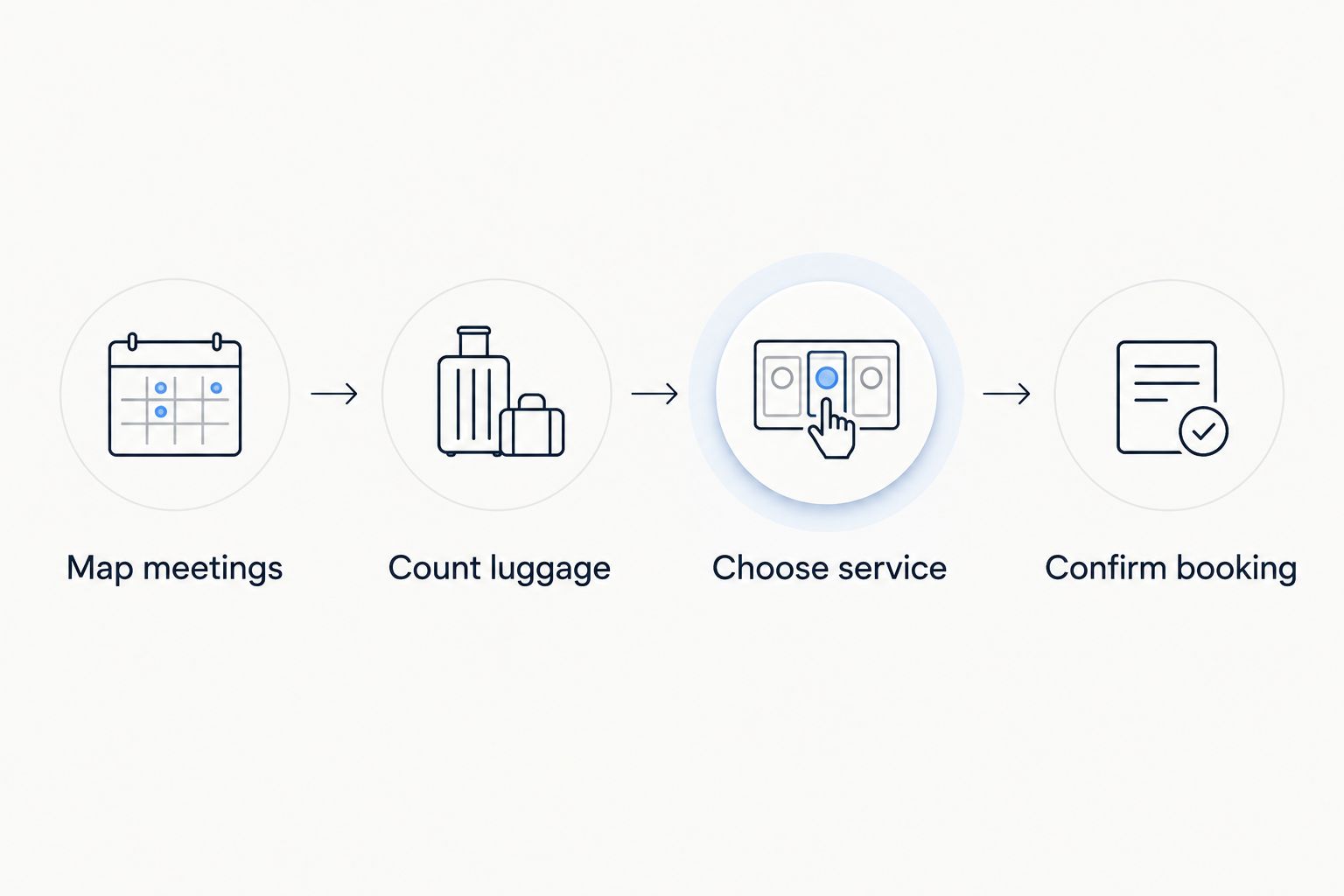
Use this sequence before paying. It separates the meeting plan from the vehicle reservation and keeps essential passenger details together.
- Map meetings: List every pickup, destination and planned departure.
- Count luggage: Include suitcases, presentation materials and personal bags.
- Choose service: Select hourly hire, individual transfers or a cross-border arrangement.
- Confirm booking: Check the journey scope, payment and passenger instructions.
The seven-seat MPV format includes the driver’s seat. It carries up to 6 passengers with 3 large suitcases or 6 small bags per car; do not count seven passenger places.
Bookings made at least 3 days ahead have a guaranteed car. Inside 3 days, confirmation is usually provided within about 5 minutes after payment, or a full refund applies.
For payment, your instant quote is final. Distinguish point-to-point inclusions from hourly charter parking and tolls before approving the booking.
Plan your roadshow transport
Review chauffeur-driven charter and transfer options for your meeting itinerary.
How these options are ranked
The order follows the roadshow task: continuous local transport first, recurring administration second, then individual journeys, airport arrivals and regional travel. The criteria are driver continuity, passenger fit, route coverage, charge boundaries and change handling.
This is a service-fit comparison, not a claim that one operator outperforms another. Each recommendation has a different booking purpose.
Which roadshow charter should you choose?
Choose hourly chauffeur charter if your team needs the car between several Hong Kong meetings. Use individual transfers when the journeys are separate and the car does not need to wait.
Add a corporate account for repeat booking administration, an airport transfer for flight-linked arrivals, or a cross-border arrangement for regional meetings. Do not let the account type or vehicle description replace deciding what the driver must do.
FAQ
What’s the best corporate roadshow car charter Hong Kong arrangement?
Hourly chauffeur charter is the right default when your team needs transport between several meetings. Choose point-to-point transfers when you only need separate journeys and do not need the driver retained.
Does a seven-seat car carry seven business passengers?
No. The seven seats include the driver, leaving space for up to 6 passengers. The stated luggage capacity is 3 large suitcases or 6 small bags per car.
Can my company arrange monthly settlement?
Mayline corporate accounts support monthly settlement by written agreement. The account also provides a web portal for bookings and change requests, plus monthly statements by currency.
Are parking and tolls included in hourly charter?
Parking and tolls are paid on the day for hourly charter. Point-to-point fares include tolls, tunnel and border fees, so check the booking type before approval.
How does an airport pickup handle a delayed flight?
Airport pickups use flight tracking and include 60 minutes of free waiting from actual landing. Confirm the onward journey separately if the traveller needs transport for later meetings.
Can everyone stay in the car at the border?
No. Mainland China journeys require passengers to leave the car at the mainland checkpoint and rejoin it afterwards. Macau entry procedures depend on passenger documents, and officers determine procedures for other directions.
When will the driver details be provided?
The driver’s name, phone number and vehicle plate appear on the My order page no later than 1 hour before pickup. A shared chat connects the traveller, customer service and driver in the traveller’s own language.
One last thing
Send the luggage count with the meeting agenda, not after the car is booked. A team that fits the passenger seats still needs space for its bags and presentation materials.
Confirm people, luggage and journey scope together. That is the final check before turning a roadshow itinerary into a transport booking.