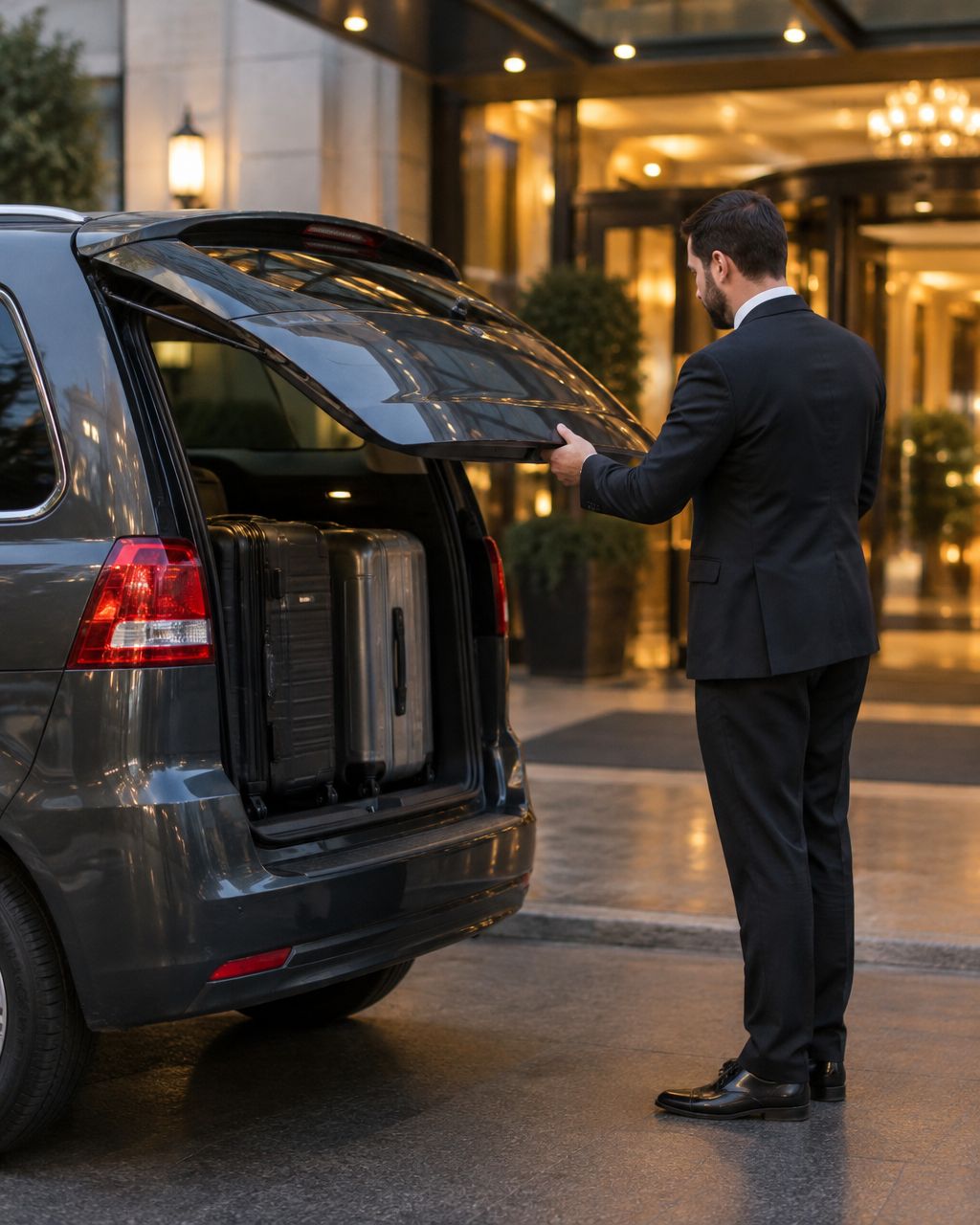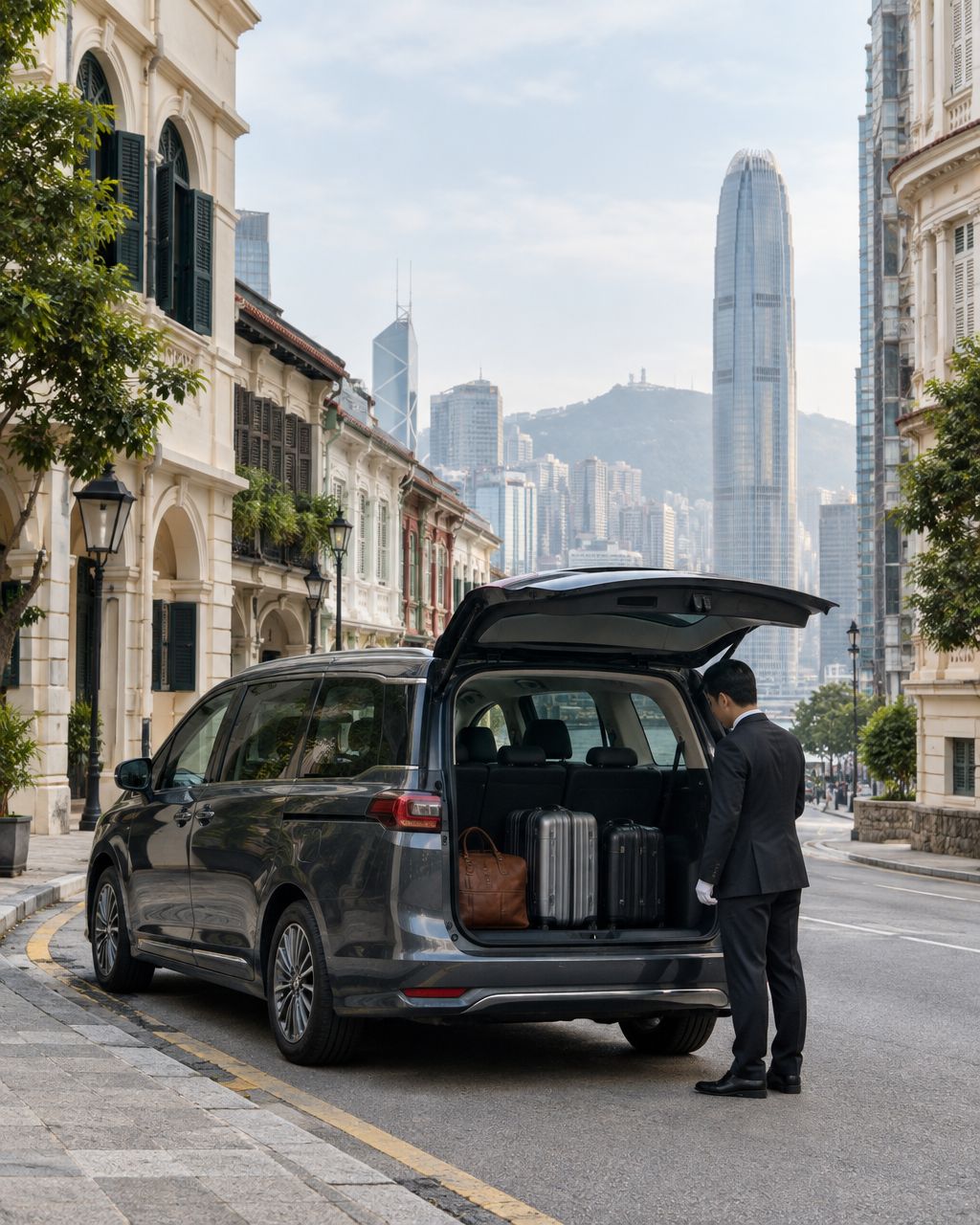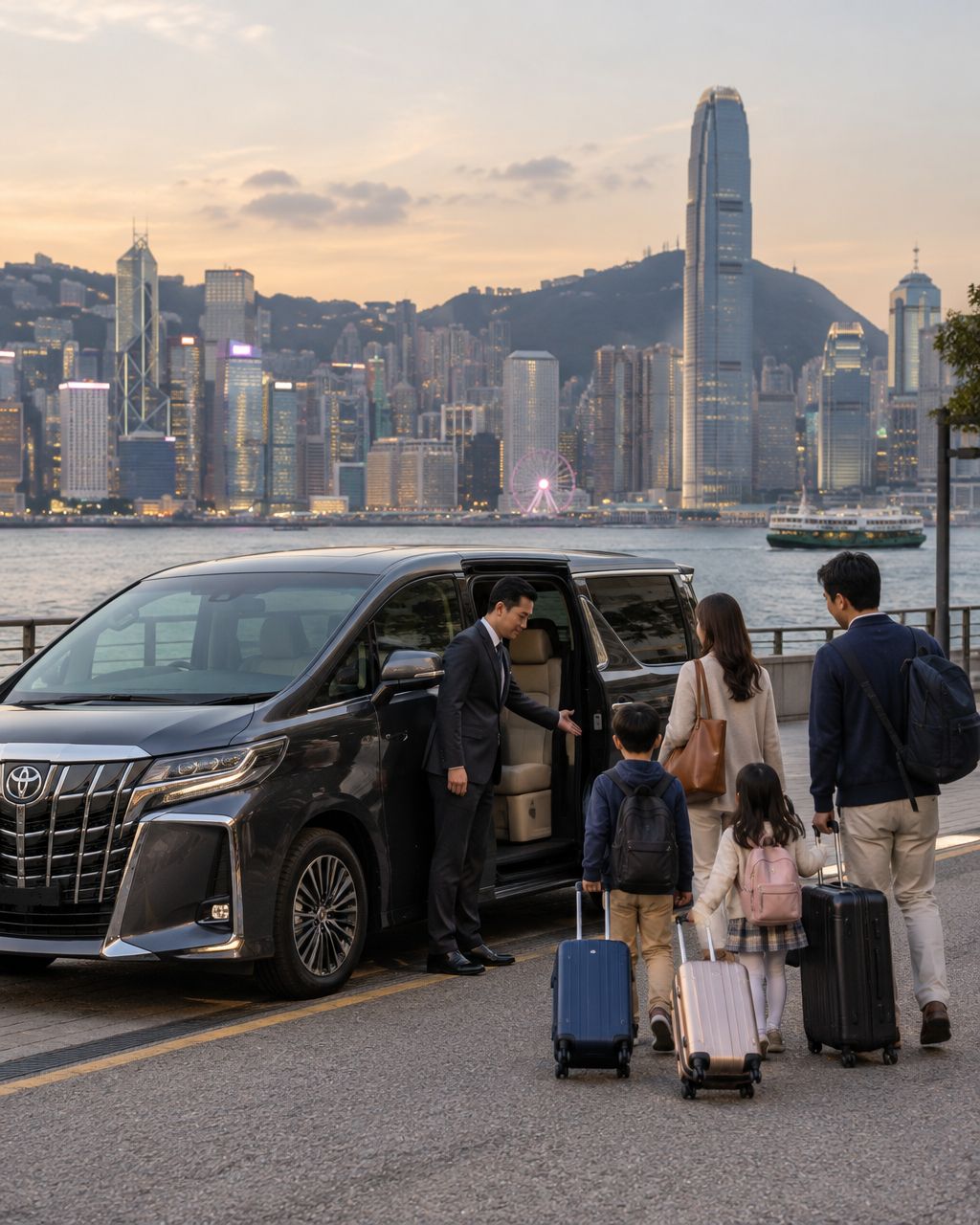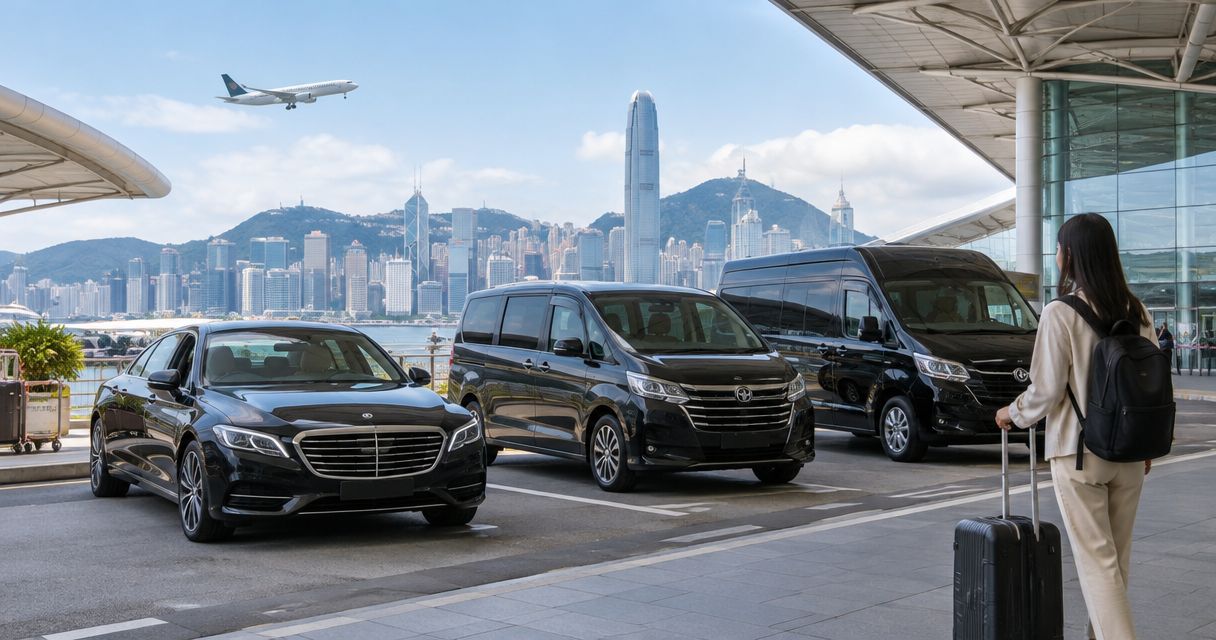
Best for light luggage: a taxi or pre-booked sedan. Best for a family within the stated luggage allowance: a Mayline MPV. Best for a group that exceeds one MPV’s capacity: a booked minibus or coach, with capacity confirmed before payment. This 2026 Hong Kong airport transfer vehicle size guide ranks options from smaller to larger—not by operator quality.
- Choose your Hong Kong airport transfer vehicle size by passengers and luggage together, not seats alone.
- Mayline airport transfers suit families needing up to six passenger places within the stated luggage allowance.
- Choose a minibus or coach when your party exceeds one MPV’s confirmed capacity.
- For 2026 bookings, confirm child seats, oversized bags and the actual vehicle category before paying.
Why vehicle size matters
An airport transfer needs room for the people and everything travelling with them. A vehicle with enough passenger seats is not automatically suitable for your suitcases, pushchair or wheelchair.
Mayline specifies seven-seat MPVs including the driver’s seat, carrying up to 6 passengers with 3 large suitcases or 6 small bags. Treat those passenger and luggage limits as a combined booking check, not separate promises that any load will fit.
Mayline airport transfers suit families needing up to six passenger places within the stated luggage allowance. A smaller party with bulky equipment still needs its load checked before choosing this category.
What makes the best airport transfer vehicle size?
Use these criteria before comparing vehicle names. For your 2026 booking, send the same passenger and luggage details with every enquiry so you can compare like for like.
- Passenger places: Count every traveller, including children. Check whether the advertised seat count includes the driver.
- Luggage space: State the number and type of bags. Include cabin cases, pushchairs and equipment rather than counting only checked suitcases.
- Child-seat fit: Request the child seats you need and confirm the seating arrangement. Do not assume a spare seat solves the installation question.
- Boarding needs: Explain any difficulty stepping into a vehicle or transferring from a wheelchair. A larger vehicle does not automatically provide suitable access.
- Collection and drop-off: Check where you meet the vehicle and whether it can serve your destination’s entrance.
- Journey type: Distinguish a Hong Kong hotel transfer from a cross-border journey. Border permissions and procedures matter as well as vehicle size.
Airport transfer sizes at a glance
The order below moves from smaller vehicles to larger group transport. It is a decision tree: stop at the smallest category that has confirmed space for your full load.
| Size option | Best for | Standout feature | Key limitation |
|---|---|---|---|
| Taxi or pre-booked sedan | A small party travelling light | A smaller vehicle category for a straightforward transfer | Passenger places and boot space must both fit your booking |
| Chauffeur-driven MPV | Families or colleagues travelling together | Passenger seating and luggage space in one booked car | An MPV is not a substitute for a luggage van |
| Booked minibus | A group exceeding one MPV’s capacity | A group-sized vehicle rather than separate smaller cars | Confirm actual luggage storage and collection arrangements |
| Booked coach | A larger organised group | A vehicle category intended for group transport | Access and loading arrangements need advance planning |
1. Taxi or sedan: best for a small party travelling light
A taxi or pre-booked sedan is the first category to consider when your party and bags fit a smaller vehicle. These are different booking arrangements, so check the actual vehicle rather than treating the category name as a capacity guarantee.
Best for: A small party with ordinary luggage and no requirement for a larger cabin.
Taxi or sedan pros:
- Keeps the vehicle choice focused on the space you actually need.
- Supports a point-to-point journey rather than a transfer between scheduled services.
- A pre-booking enquiry lets you describe your luggage before accepting a vehicle.
Taxi or sedan cons:
- Boot space varies by vehicle; the word “sedan” does not confirm suitcase capacity.
- A pushchair or oversized case needs a separate fit check.
- Child-seat requirements need confirmation for the specific arrangement.
Choose this category by your load, not by the fact that you are travelling alone or as a couple. Two travellers with bulky equipment need a different assessment from two travellers carrying small bags.
For a taxi, follow the airport’s current taxi arrangements and use a vehicle suitable for your destination. For a pre-booked sedan, ask the provider to confirm passenger places, luggage acceptance and the meeting point together.
Verdict: Buy this category only when the full passenger and luggage load is confirmed to fit.
2. Chauffeur-driven MPV: best for families travelling together
An MPV brings your party into one booked vehicle with a professional driver. Mayline uses seven-seat MPVs, mainly Toyota Alphard, with seven seats including the driver—not seven passenger places.
Best for: Families or colleagues within the limit of 6 passengers and 3 large suitcases or 6 small bags per car.
Mayline MPV pros:
- Every booking is a whole car with a professional driver.
- Child seats are free; request the seats your children need when booking.
- Airport pickups include flight tracking and 60 minutes of free waiting from actual landing.
- Vehicles are licensed for hire and covered by commercial insurance.
Mayline MPV cons:
- Six passenger places do not mean space for six large suitcases.
- A pushchair, mobility aid or unusual load needs confirmation alongside the bags.
- An MPV booking is not a self-drive rental or a larger group vehicle.
The important distinction is between seating capacity and luggage capacity. If six people each bring a large suitcase, their bags exceed the stated large-suitcase allowance for one car. Do not book on passenger count alone.
For a 2026 airport arrival, submit the flight details, destination, passenger count, bag count and child-seat request together. That gives the booking a clear brief rather than leaving the driver to resolve a space problem at collection.
Verdict: Buy for a family or colleague group whose people and bags both fit the stated limits.
3. Booked minibus: best for groups beyond one MPV
A booked minibus is the next category to assess when one MPV cannot carry your group or luggage. The vehicle name alone does not establish how much storage remains once everyone is seated.
Best for: A group that wants to travel together but exceeds one MPV’s confirmed capacity.
Booked minibus pros:
- Gives the group a larger vehicle category to assess before splitting into cars.
- Allows one collection brief and one destination plan for the party.
- Lets the organiser confirm seating and luggage requirements in advance.
Booked minibus cons:
- Seat count alone does not establish room for everyone’s suitcases.
- Child-seat arrangements and boarding access need vehicle-specific confirmation.
- Collection and drop-off locations require checking for the booked vehicle.
Ask for confirmation of the actual passenger capacity with your luggage on board. A description such as “group vehicle” is not a substitute for that answer.
Also compare a minibus with separate smaller cars. The minibus suits a party that wants to remain together; separate cars split the passengers, bags and arrival coordination. Neither arrangement is automatically better.
Before booking, name a lead passenger and provide a single, agreed luggage list. A group enquiry becomes much clearer when the organiser includes the equipment that individual travellers might otherwise forget to mention.
Verdict: Buy when the provider confirms the whole group, luggage and collection arrangements in the same vehicle.
4. Booked coach: best for a larger organised group
A coach belongs in the discussion when your passenger and luggage requirements exceed smaller group vehicles. Confirm the specific vehicle and itinerary rather than relying on the word “coach”.
Best for: A larger party with an organiser coordinating airport collection and destination access.
Booked coach pros:
- Provides a group-transport category for a larger passenger brief.
- Supports an organised collection with a named group leader.
- Allows luggage handling and destination access to be planned together.
Booked coach cons:
- A hotel entrance suitable for a car is not automatically suitable for a coach.
- Boarding and loading arrangements require advance coordination.
- The group needs a clear plan if passengers leave the arrivals area separately.
Confirm the agreed boarding location, the luggage arrangement and the destination’s access requirements. Ask the hotel or venue about the proposed drop-off, rather than assuming the coach can stop at its front door.
A coach is not the default upgrade for a family with extra bags. It is a group-planning choice. Compare the confirmed coach arrangement with smaller vehicles using the same passenger list and luggage inventory.
Verdict: Buy for a larger organised party after access, storage and boarding are confirmed.
Match the vehicle to your actual load
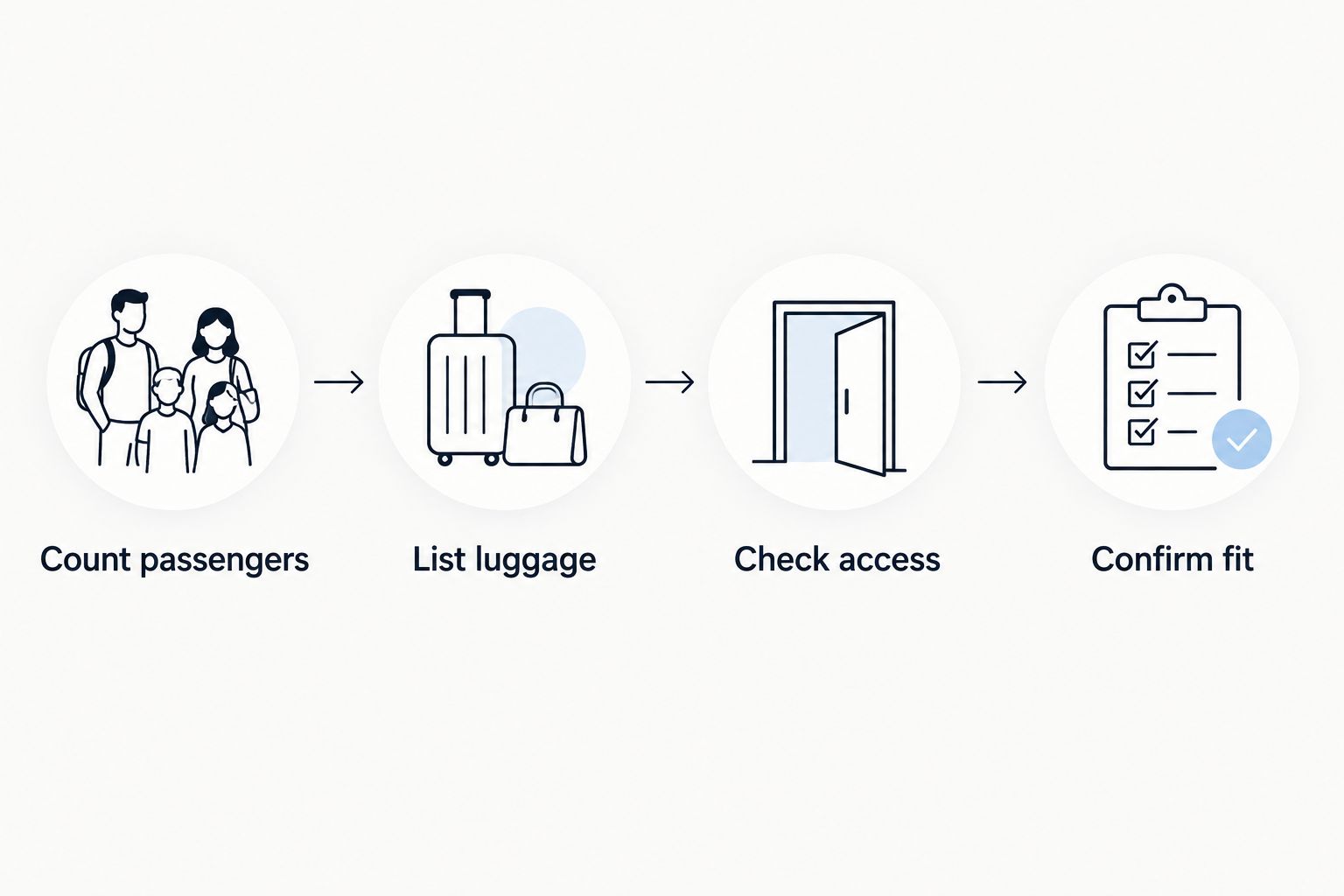
Use this sequence before paying for your 2026 airport transfer. Keep one written list and update it if another traveller joins or the luggage changes.
Count passengers
Include adults and children in the passenger total. Record child-seat requests separately so the provider can confirm the seating arrangement, not just the headcount.
List luggage
Separate large suitcases, small bags and unusual items. Do not describe a pushchair, golf bag or folded wheelchair simply as another suitcase.
Check access
Explain boarding needs and confirm the destination entrance. If someone must remain in a wheelchair during travel, ask specifically about a suitable vehicle and restraint arrangement; an ordinary MPV description does not establish either.
Confirm fit
Ask the provider to accept the complete passenger and luggage list for the booked vehicle category. Keep that confirmation with your booking details.
A photograph or measurements help explain an unusual item, but the provider still needs to confirm acceptance. Do not leave the question until the vehicle reaches the airport.
What changes if your destination is across the border?
A Hong Kong airport transfer to a Hong Kong hotel and a journey to Macau or mainland China have different requirements. Vehicle size is only one part of the booking.
For a direct Hong Kong–Macau journey, the same car travels door to door. A transfer arrangement instead involves one change of car at a designated transfer point. Make sure your luggage plan works for the arrangement you select.
Border procedures also depend on direction and entry documents. At HZMB Macao Port, nationals of Macau visa-free countries with valid passports may stay in the car; travellers needing a Macau visa or Entry Permit clear through the relevant inspection hall and rejoin the same car. The Macau Public Security Police is the official source for entry requirements.
For mainland China journeys, passengers get out at the mainland checkpoint and then rejoin the same car. Leaving Hong Kong or travelling from Macau to Hong Kong remains subject to officers’ instructions on the day. Never plan around a promise that everyone stays seated throughout.
How these vehicle options are ranked
This 2026 ranking follows increasing vehicle size and a distinct use case for each category. It does not rank operators, claim road-test results or assume that a larger vehicle is a better transfer.
The deciding criteria are passenger places, luggage fit, child-seat arrangements, boarding access and route suitability. Choose the smallest category with confirmed capacity for all of them—not the smallest category with enough seats.
Which airport transfer vehicle size should you choose?
Start with your luggage list, then select the vehicle. A taxi or sedan fits the light-luggage brief; an MPV fits a family or colleague group within its stated limits; a minibus or coach needs a group-specific capacity and access check.
For Mayline bookings, your instant quote is final. Bookings made at least 3 days ahead have a guaranteed car. For bookings inside 3 days, confirmation usually arrives within about 5 minutes after payment, or a full refund applies.
Driver details appear on the My order page no later than 1 hour before pickup. Keep the booking details accessible and make sure the lead passenger can receive messages on arrival.
FAQ
What's the best Hong Kong airport transfer vehicle size for a family?
An MPV is a suitable choice when the family and its luggage fit the confirmed limits. Mayline specifies up to 6 passengers with 3 large suitcases or 6 small bags per car; include child seats and pushchairs in your booking request.
Does a seven-seat airport transfer carry seven passengers?
Not when the seven-seat count includes the driver. The MPVs described here provide up to six passenger places, so check how every provider states its capacity.
Can six passengers bring six large suitcases in one MPV?
Six large suitcases exceed the stated three-large-suitcase allowance for the MPV service described here. Ask for a different confirmed transport arrangement rather than booking by passenger count alone.
Should I book a minibus or separate airport transfer cars?
Book a minibus when the provider confirms space for the whole party and luggage and you want to travel together. Separate cars split the party and require you to assign passengers and bags to each vehicle.
Do I need to book a larger car for a child seat?
A child seat requires confirmation of the seating arrangement, not an automatic vehicle upgrade. Give the provider your passenger count, child-seat requirements and luggage list together.
How much does a larger Hong Kong airport transfer cost?
Use a route-specific quote rather than treating vehicle size as a complete cost estimate. Enter your journey, pickup time, passenger count and luggage details, then review the confirmed arrangement before paying.
Can I stay in the car during an airport transfer to Macau?
That depends on your entry documents, direction of travel and officers’ instructions. At HZMB Macao Port, nationals of Macau visa-free countries with valid passports may stay in the car; travellers needing a Macau visa or Entry Permit use the relevant inspection hall.
One last thing
Count the journey home as a separate luggage check. If you expect to return with more bags, confirm the return vehicle against that larger load when booking; the right car for your arrival is not automatically the right car for your departure.